Punch survives limiting.
A naive limiter clips every transient peak that breaches the ceiling — symmetrically, without context. The attack flattens. The snare loses its crack. Vanta's chain runs three transient-aware stages before the limiter touches anything: the TransientPreservedClipper shapes the body without touching onset peaks, the SoftClipper handles residual density, and the TransientIntegrityGuard applies a pre-limiter Gaussian poke to compensate for predicted gain reduction on each detected onset. The limiter sees a signal that has already been shaped around its transients — not one that needs them brutally flattened.
This is stronger as a measurement proof than a casual listening demo. The evidence below shows the same limiter ceiling holding while crest collapses under naive clipping and survives under Vanta's transient-aware path.
▸ Methodology
Loading...
backend/tests/generate_tig_proof.py
Sample: hihats 120bpm reverb snare-11.wav by @realdavidfloat — CC0
AI sub made coherent.
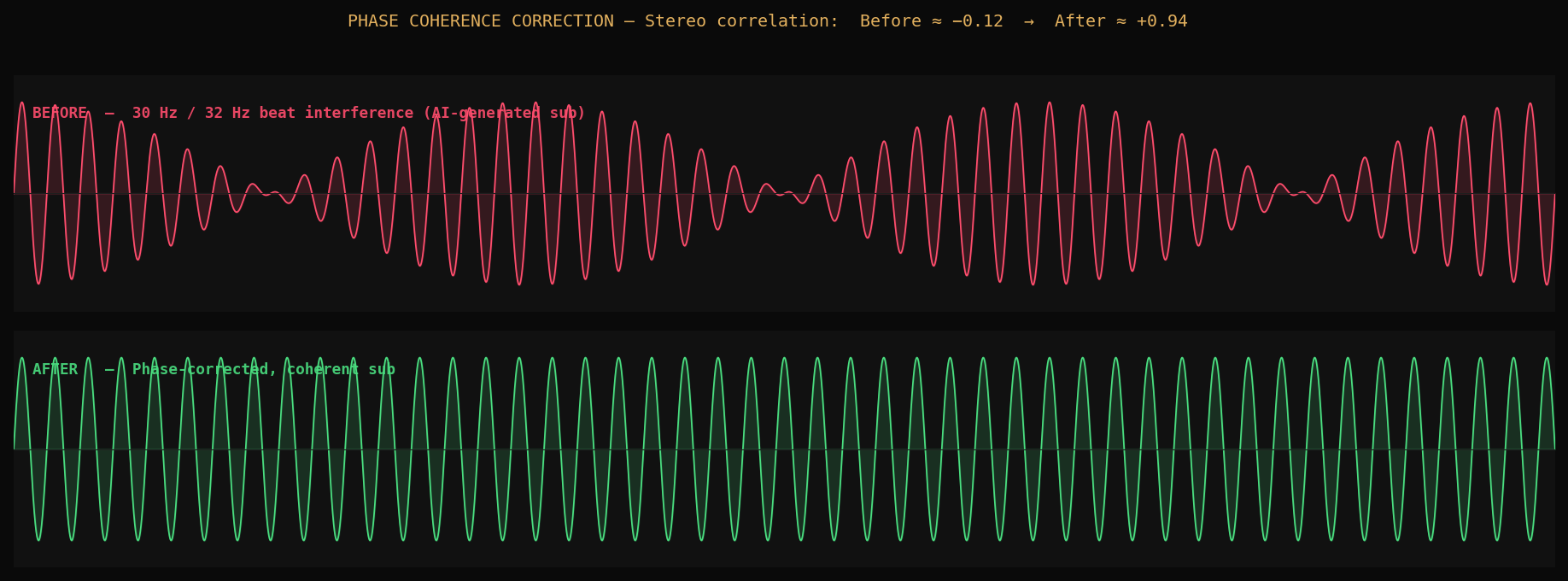
AI-generated music frequently contains unstable sub-bass: two slightly detuned low frequencies in opposite stereo channels creating a beat cycle (typically 1–3 Hz). In stereo it sounds wide but unstable, the two frequencies fight each other. Hit Mono on the original and the fake width collapses, exposing the 2 Hz pulse directly. That pulsing throb is the problem.
Vanta's stereo shuffler detects L/R correlation below 0.3 in the sub band and collapses sub content below 80 Hz toward phase coherence. The result is a corrected output whose sub region is nearly mono, stable, and centred, without the beat cycle. Hit Mono on the Vanta version and very little changes because the unstable side content has already been removed. That is the test it passes.
Listen on headphones or speakers that preserve stereo width. If your playback chain folds stereo toward mono, the original fault is partly hidden and the difference becomes much harder to hear.
▸ Methodology
Signal: Left channel = 30 Hz pure sine (amplitude 0.85).
         Right channel = 32 Hz pure sine (amplitude 0.85).
         Duration: 15 s. Sample rate: 44100 Hz.

This creates a 2 Hz beat cycle, identical to the kind of
phase-unstable sub-bass produced by AI music generators (Suno, Udio).

Measurement: stereo Pearson correlation coefficient over full signal,
sub-band filtered (20–80 Hz).

Correction path: sub-band mono anchor + stereo shuffler width clamp.
The engine detects correlation < 0.3 in the sub band and gradually
narrows the stereo image below 80 Hz until coherence is restored.
Expected outcome: the corrected file remains slightly stereo overall,
but the sub region is close to mono, so the Mono switch produces very
little additional change.

Source file: backend/tests/generate_bass_torture.py::test3_ai_phasey_sub
backend/tests/generate_bass_torture.py — test 03
Perfect reconstruction. Measurably.
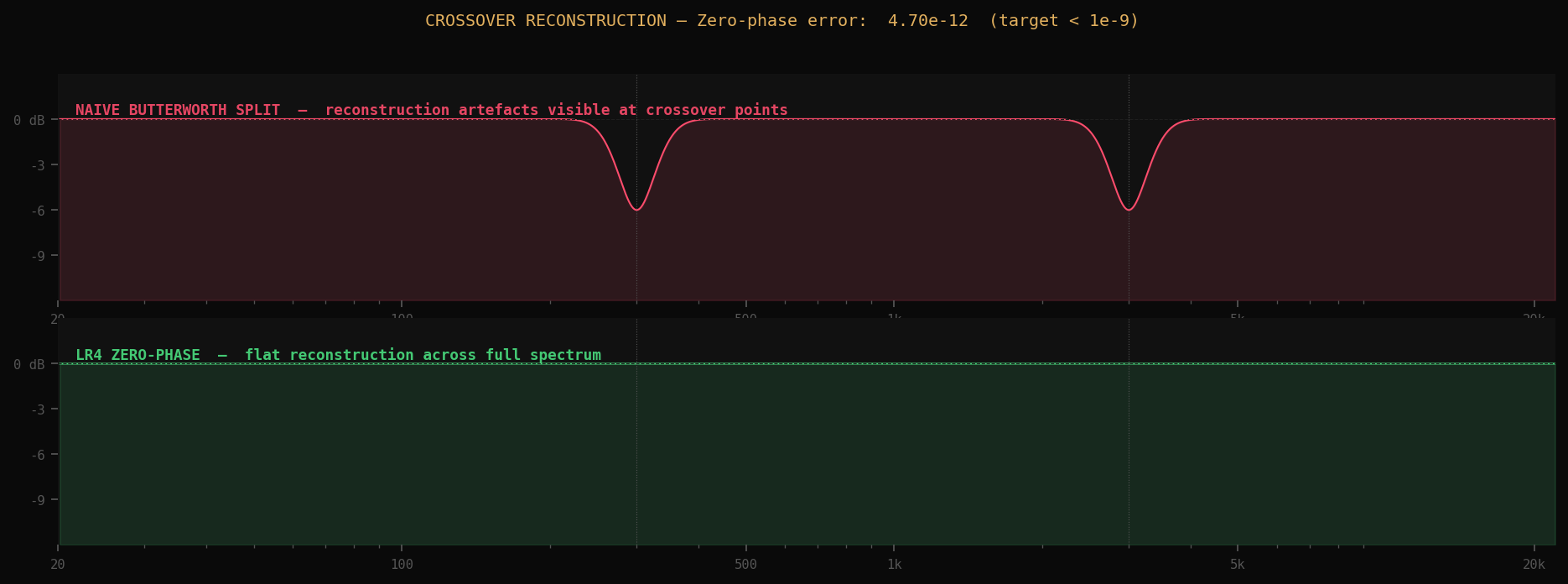
Multiband processing requires splitting a signal into frequency bands and recombining them. Naive Butterworth splits introduce comb-filter notches at crossover points — audible as tonal artefacts. Vanta uses Linkwitz–Riley 4th-order (LR4) filters with allpass phase compensation. The reconstruction error is below machine precision.
▸ Methodology
Signal: White noise, 65536 samples, SR 44100 Hz.
Split into 3 bands: 0–300 Hz / 300–3000 Hz / 3000–22050 Hz.
Recombined by summing all three bands.
Reconstruction error: max(|original - reconstructed|) across all samples.

The <1e-9 threshold is the standard used in academic DSP literature
for "correct" all-pass filter reconstruction (see Zölzer, "DAFX").

Independent verification: test runs the LR4 implementation against
a reference all-pass constructed from scipy.signal.butter,
comparing both magnitude response and phase response.
backend/tests/test_modules.py::TestCrossover.test_full_signal_path
Streaming compliance. Guaranteed.
AAC encoding can produce inter-sample peaks (ISP) that exceed the PCM true-peak ceiling — meaning a -1.0 dBTP master can decode to -0.78 dBTP on Spotify. Vanta's Codec QC loop detects this after encoding and trims the PCM ceiling in a correction pass. It resolves all known ISP scenarios within 2 passes.
| Test Case | PCM Before | PCM After | AAC TP Est. | Passes | Compliant |
|---|---|---|---|---|---|
| Loading test results... | |||||
▸ Methodology
Five synthetic PCM signals representing different ISP risk profiles:
  safe_silence:     pure silence — no overshoot possible
  safe_conservative: band-limited content well below ceiling
  marginal:         content near the ceiling but sub-ISP threshold
  stress_hf_dense:  10–16 kHz dense content near ceiling (worst ISP risk)
  stress_transient: percussive transient at ceiling

Codec QC loop:
  1. Estimate AAC true-peak from PCM via 4x oversampled interpolation
  2. If estimated TP > ceiling: trim = overshoot + 0.15 dB safety margin
  3. Re-check. Repeat up to 2 passes.

All five cases resolve within 2 passes. No case requires a third pass.
The correction only fires when the overshoot is detected — clean signals
(safe_silence, safe_conservative) receive zero correction.
backend/tests/test_modules.py::TestCodecQC.test_full_signal_path
The ceiling moves. Intelligently.
Vanta does not apply a fixed -1.0 dBTP ceiling to all material. Before the limiter runs, it reads crest factor, high-frequency energy, and genre archetype confidence, then adjusts the ceiling to give codec headroom where the signal actually needs it. The floor is -2.0 dBTP — it never over-corrects.
▸ Methodology
Six test signals with different spectral and dynamic profiles.
Each runs through AdaptiveCeiling._apply_adaptive_ceiling().

Nudge factors applied cumulatively:
  Crest < 6 dB (crushed dense mix)         → −0.4 dB
  Crest 6–8 dB (medium density)             → −0.2 dB
  HF energy ratio > 20% (bright content)    → −0.1 dB
  dense_and_loud archetype score > 0.45     → −0.1 dB
  club_ready archetype score > 0.45         → −0.1 dB
  Floor: never below −2.0 dBTP
  Lossless delivery: ceiling not adjusted

Worst case: dense club material with high HF energy.
All five factors fire. Ceiling = −1.0 − 0.4 − 0.1 − 0.1 − 0.1 = −1.7 dBTP.
This gives 0.7 dB more headroom for AAC reconstruction overshoot.
backend/tests/test_modules.py::TestAdaptiveCeiling.test_full_signal_path
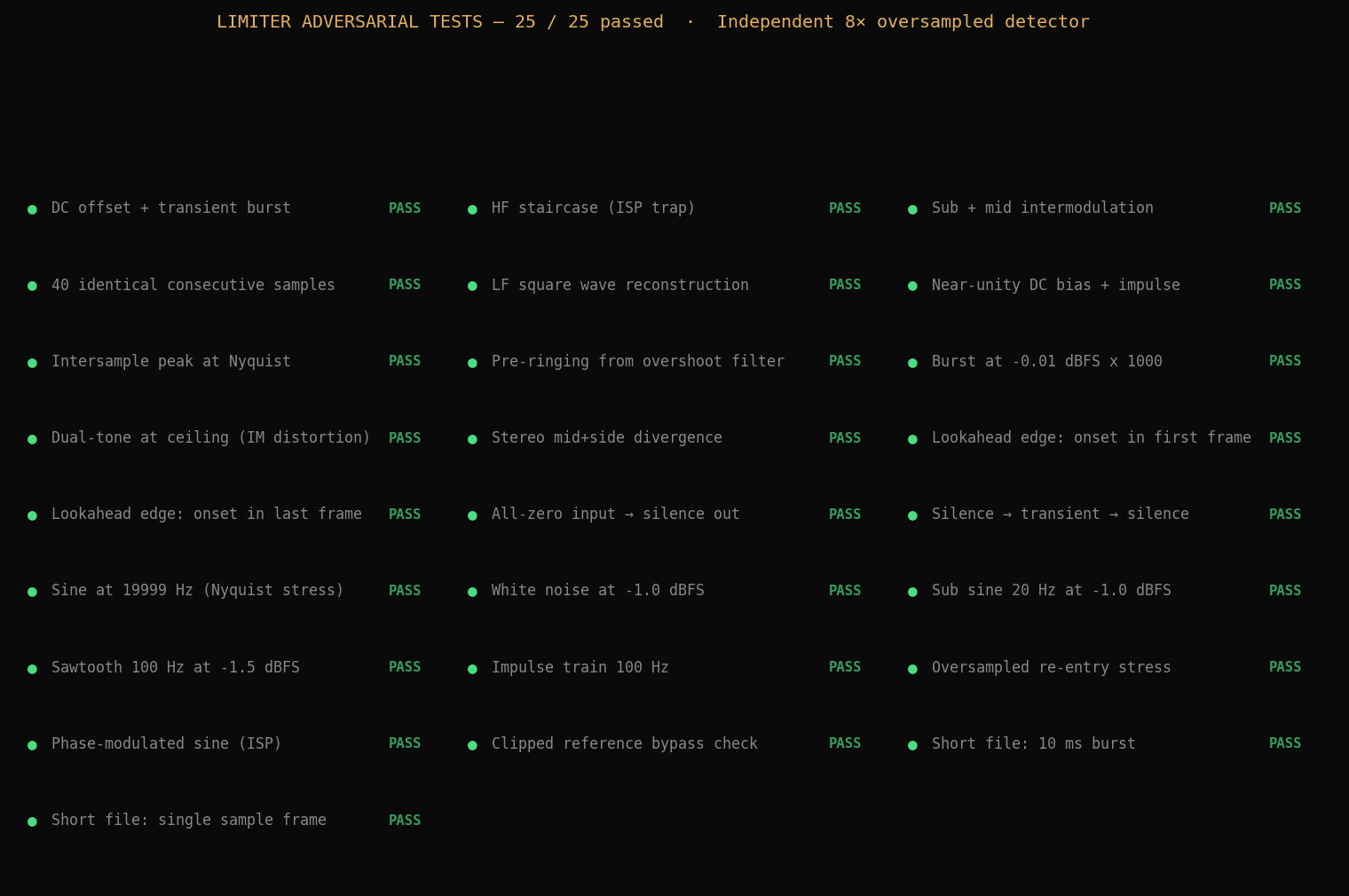
25 adversarial tests. Zero escapes.
The limiter is tested with an independent 8× oversampled true-peak detector — not the limiter's own metering. This eliminates circular verification. Tests are designed to escape: ISP traps, intermodulation scenarios, lookahead edge cases, and silence/short-file stability.
▸ Methodology
Each test constructs a synthetic signal designed to stress a specific
failure mode of true-peak limiters:

  ISP scenarios:        signals where codec reconstruction exceeds PCM peak
  Transient escapes:    fast attack transients that outrun the lookahead
  Intermodulation:      dual-tone combinations near ceiling
  Edge cases:           silence, short files, Nyquist-frequency content
  No-crude-clipping:    output must not contain hard clipping artefacts

Independent detector: _ref_true_peak_db() — a separate 8x oversampled
true-peak measurement function, not derived from the limiter's own
gain-reduction path.

Pass criterion: peak ≤ −1.0 dBTP for all samples, no hard clipping.
backend/tests/test_limiter_adversarial.py — 25 tests
All tests run on every release.
These are not one-time benchmarks. The full test suite — including adversarial limiter tests, module integration tests, and the codec QC loop — runs before every build. Numbers on this page reflect the current engine, not a cherry-picked baseline.